

What is cashmere?
You are holding something, or about to buy something, and the label says cashmere. Here is what the word actually means.
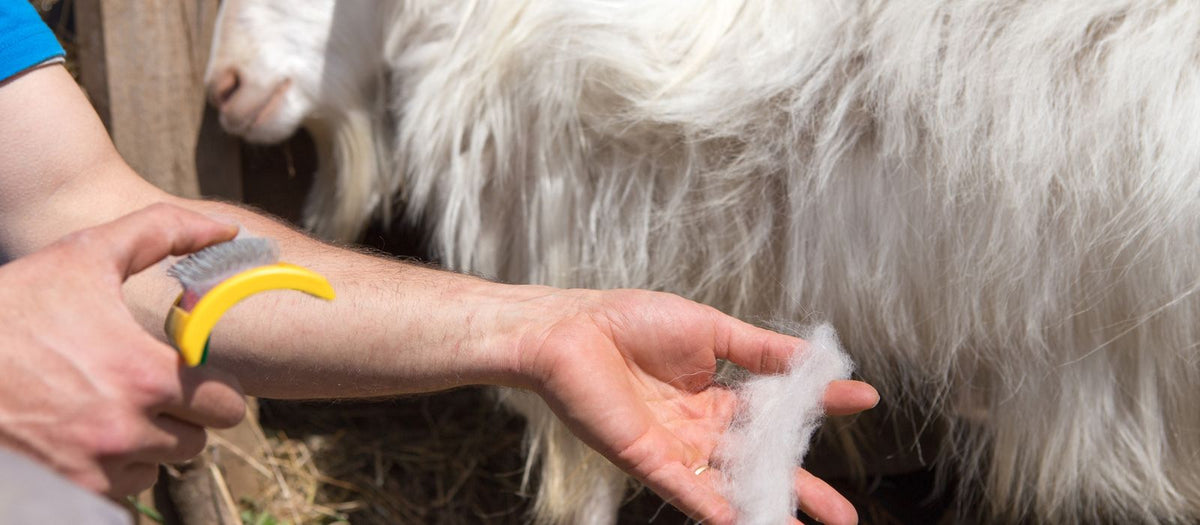
Cashmere is the fine undercoat of a goat. Underneath the coarse outer hair that keeps the weather off a cashmere goat, there is a soft layer that keeps its warmth in — and that layer is the cashmere. Every spring the goat sheds it, and in the places it is done properly, it is combed out by hand rather than shorn. Combing takes only the down and leaves the animal its outer coat. It is slower than shearing and yields far less.
A goat gives a few ounces of usable down a year. A single knit takes the yield of several animals. That is the whole explanation of what cashmere costs, and there isn't a more complicated one.
How it differs from wool
Wool comes from sheep. Cashmere comes from a goat, and the difference you feel is diameter. A fine merino fibre sits around 19 microns. Cashmere has to average no more than 19 microns to be legally sold as cashmere in the United States at all, and good cashmere runs well under that. Put next to a hair from your own head — 50 to 100 microns — a cashmere fibre is roughly one-sixth as thick.
That is the entire reason it can be warm without being heavy. A fibre that fine bends easily, so it lies flat against the skin instead of standing off it.
The hollow fibre, and why you keep reading that
Cashmere is often described as hollow. It isn't.
Cashmere down is solid — non-medullated — and that is part of the definition rather than an accident. The hairs that are hollow are the coarse guard hairs from the animal's outer coat, and an entire processing stage exists to take them out. It's called dehairing, and it is one of the places cheap cashmere is made cheap.
Is cashmere itchy?
Good cashmere isn't, and if something is, the reason is usually specific. Press it to the inside of your wrist and wait. You should feel nothing. A faint scratch means guard hair was left in and the dehairing was rushed.
That test takes two seconds and tells you more than the label will.
What separates one cashmere from another
Two numbers, and most sellers quote one.
Fineness is what you feel in the shop. Under about 16 microns is good. Above 19 it cannot legally be called cashmere.
Staple length is what you feel in year three. Long fibres stay anchored in the yarn; short ones work loose under friction and gather into pills. Thirty-two millimetres and up is what you want. Under twenty-eight is the one that feels wonderful on the rail and disappoints by the second winter.
Two cashmeres can measure identically on fineness and behave nothing alike. This is why buying on softness alone is a poor way to buy — and it is a large part of why the price of cashmere varies so widely.
Why "Grade A" tells you nothing
You will see it everywhere. There is no enforced definition behind the phrase and no body that audits it. Anyone may print it, and most do.
Microns and millimetres on a certificate, batch by batch, are a different kind of claim — the kind someone can check. A badge nobody checks is not evidence.
Two questions sit just behind this one and are worth answering separately: whether the combing is done humanely, which is covered in how to tell if you own cruelty-free cashmere, and how to judge weight, recovery and ply once you have the fibre in your hands.
For that last one — and for what the other fibres in a blend are actually doing — the Fiber Guide goes through it properly.
Leave a comment
This site is protected by hCaptcha and the hCaptcha Privacy Policy and Terms of Service apply.